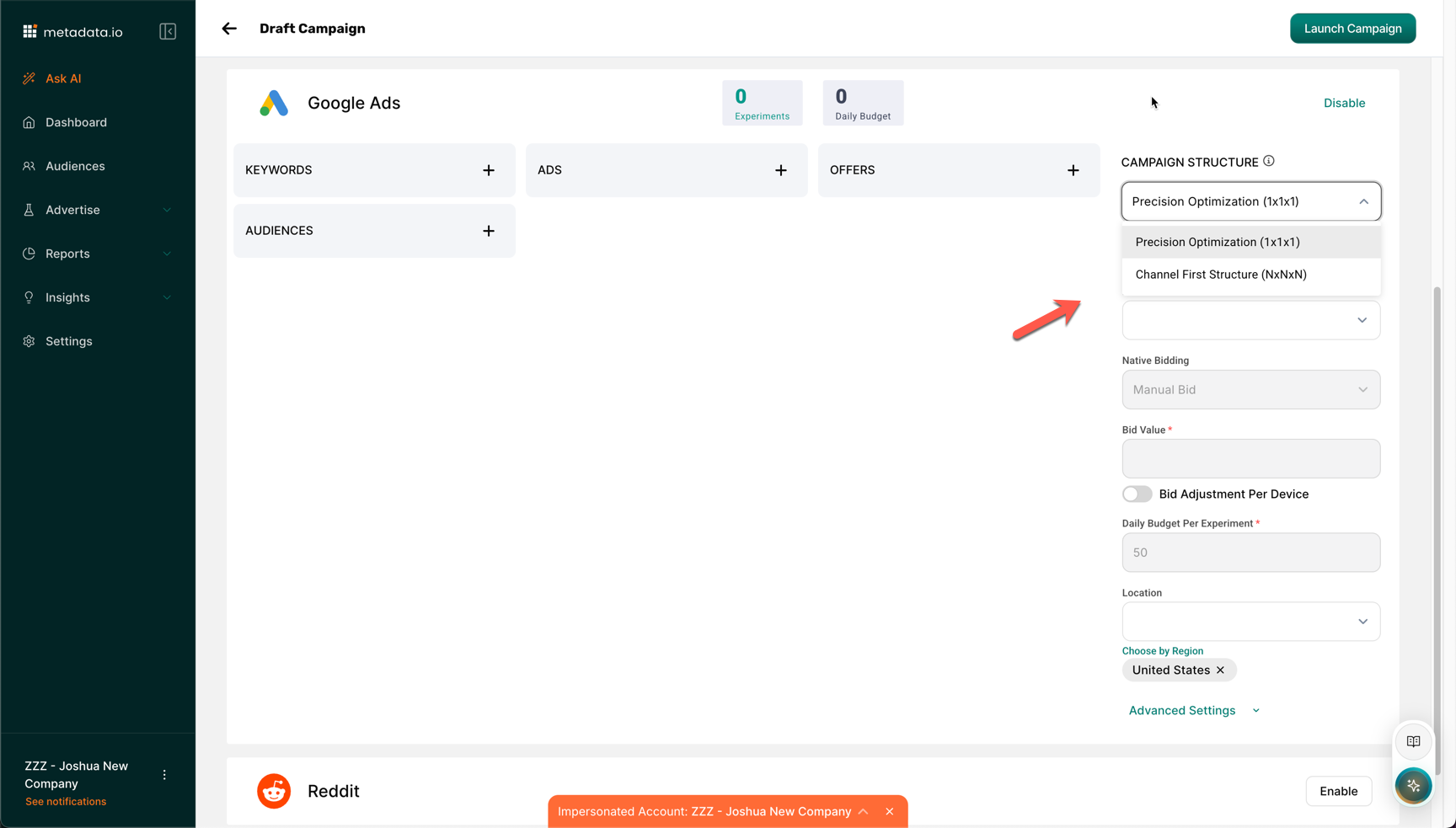
Metadata offers two different campaign structure options to meet different marketing needs. Each structure has its own unique advantages and is suitable for different use cases. This article explains both structures and helps you determine which one is right for your campaign goals.
Two Campaign Structure Options
| 1x1x1 (Multivariate Testing Structure) | NxNxN (Native Channel Structure) |
|---|---|
| Designed for automated multivariate testing at scale | Designed to mirror exact native platform structure |
How Channel Campaign Structures Work Natively
Before diving into Metadata structures, it's helpful to understand how each channel organizes campaigns natively:
| Meta (Facebook/Instagram) | |||
|---|---|---|---|
|
|
|
|
1x1x1: Multivariate Testing Structure
The 1x1x1 structure is Metadata's proprietary campaign structure designed for automated multivariate testing at scale.
How It Works
In this structure, each combination of audience, ad, and offer gets its own dedicated experiment. This allows for precise measurement and optimization of each variable.
Key Features
- Auto-score: Each experiment is scored at the most granular (ad) level
- Auto-pause: Low-performing experiments can be paused automatically at early stages
- Auto-test: Audiences, ads, offers, and creatives are tested systematically
- Auto-allocate: Daily budget is distributed by performance scores at the ad level
- Auto-adjust: Bids can be automatically adjusted to improve under-pacing
Ideal Use Cases
- You want to test many variables (ads, offers, creatives, audiences) in a fully automated way
- You have sufficient budget for multivariate testing at scale
- You're in the discovery phase with no single winning ad, audience, or offer yet
- You want fine-grained performance scoring (ad level) and auto budget allocation
- You need granular auto-pause functionality for low-performers at the ad level
Limitations
- Frequency capping may not work optimally (same ad can be shown to same user across campaigns)
- Audience overlap can affect performance (duplicate audiences may result in under-pacing)
- Native ad rotation optimization cannot be utilized (because there's only 1 ad per ad set)
- Not the most suitable structure for advertisers familiar with native platform structures
NxNxN: Native Channel Structure
The NxNxN structure mirrors the native ad platform structure, allowing more flexibility and control similar to what you'd experience working directly in the channel interfaces.
How It Works
This structure follows each channel's native organization pattern, giving you explicit setup control that mimics the exact structure of the native channel.
Key Features
- Native optimization: Leverages each platform's native algorithms (Google's Smart Bidding, Meta's Advantage+)
- Frequency control: Better control over how often users see your ads
- Add/remove flexibility: Ability to add or remove ads, offers, ad sets/groups to existing campaigns
- Audience management: Controlled at the ad sets/groups level to avoid overlap issues
Ideal Use Cases
- You already know the best performers (ads, creatives, audiences)
- You want to maximize ROI using native platform algorithms
- Native frequency caps and auction dynamics are important to your strategy
- You're running larger campaigns with more defined structure/targeting per audience
- You want to migrate an existing native campaign into Metadata with full fidelity
- Your team is already familiar with and prefers native channel structures
Limitations
- Less automation in the setup process compared to 1x1x1
- Budget Optimizer has limited granularity (at the campaign level only)
- Cannot be mixed with 1x1x1 campaigns in the same budget group
Feature Comparison Chart
| Feature | 1x1x1 Structure | NxNxN Structure |
|---|---|---|
| Multivariate Testing Granularity & Reporting | Maximum granularity at ad level. No mixing with native "ad rotation" algorithm | Reporting granularity at ad level, but mixes with native "ad rotation" algorithm |
| Setup Automation | Maximum automation for experiment creation at scale | No automation; setup is completely manual and explicit like natively |
| Native Optimization at Ad Rotation level | Native ad rotation not possible (because 1 ad per ad set) | Native optimization algorithm for "Ad Rotation" or round robin available |
| Audience Overlap Risk | Higher (duplicate audiences can result in under-pacing and oversaturation) | Controlled at the ad sets/ad groups level |
| Budget Optimizer | Highest granularity and precision (if sufficient budget and large quantity of experiments) | Limited granularity (at the campaign level only) |
| Budget Pacing Control | Strong (at the campaign level) | Strong (at the campaign level) |
| Frequency Cap Control | Weaker (can show the same ad to the same user multiple times) | Strong (controlled per ad set/group) |
| Campaign Structure Flexibility | No flexibility; 1x1x1 structure is locked | Full flexibility to add/remove ads/offers and ad sets/groups |
Conclusion
Choose the campaign structure that aligns with your marketing goals:
- 1x1x1 (Multivariate Testing): Ideal for discovery phase, automated testing, and when you need to find winning combinations quickly and efficiently.
- NxNxN (Native Structure): Best for scaling known performers, leveraging native platform algorithms, and when you need more control over campaign structure.
Both structures have their place in a comprehensive digital marketing strategy, depending on where you are in your campaign lifecycle and what you're trying to achieve.